Presentación de ejemplo · Salud
Mental health
Contenido de la presentación
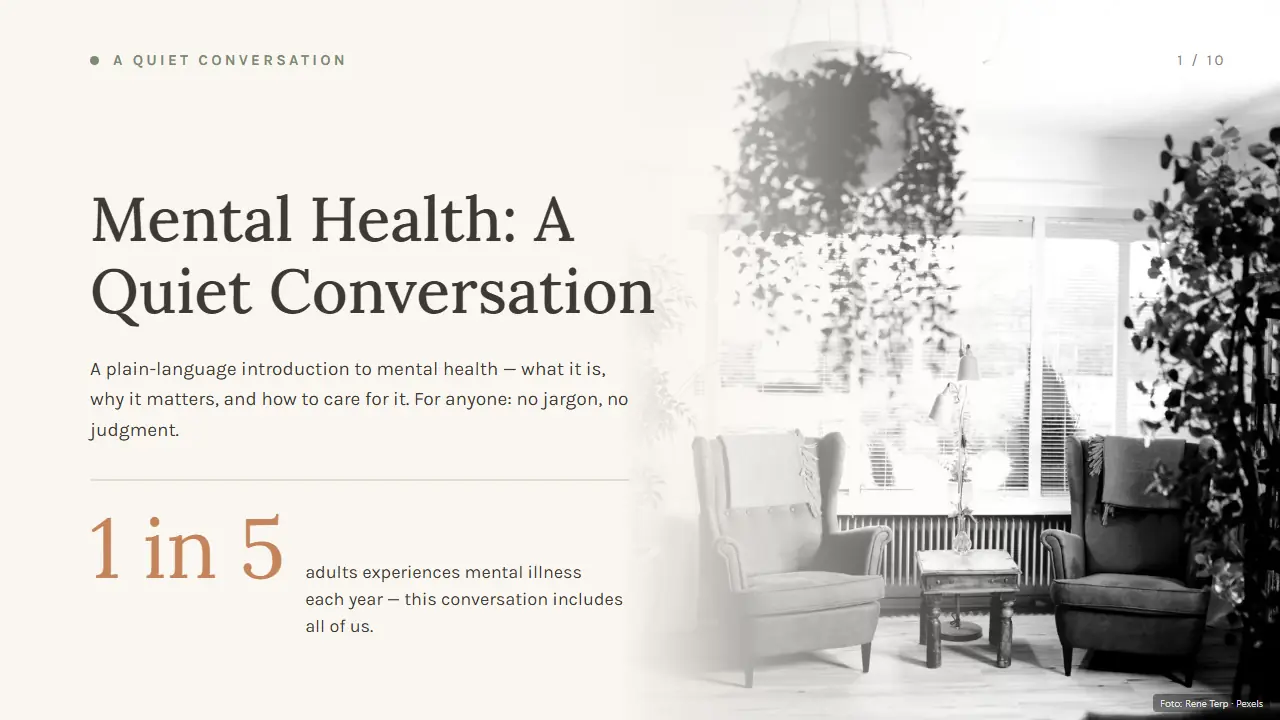
Lámina 1 Mental Health: A Quiet Conversation
A quiet conversation · A plain-language introduction to mental health — what it is, why it matters, and how to care for it. For anyone: no jargon, no judgment. · 1 in 5 adults experiences mental illness each year — this conversation includes all of us.
Lámina 2 What mental health actually is
What we mean · Mental health is more than the absence of illness. It is how we think, how we feel, how we relate to others and how we handle daily life. · Well Stressed Struggling Unwell · It sits on a spectrum: everyone moves along it — through stress, strain, struggle and recovery. · It is health. Like physical health, it can be cared for, strained, and treated. · Mental health conditions are common — far more common than most people assume. · 1 billion+ people worldwide live with a mental health condition
Lámina 3 The picture in numbers
1 in 5 · US adults experiences mental illness each year — about 58 million people. · people worldwide live with a mental health condition. · ½ & ¾ · Half of all mental illness begins by age 14; three quarters by age 24. · Sources: NAMI · WHO, 2025 · American Psychiatric Association
Lámina 4 The most common conditions
2nd · cause of long-term disability · Depression · Anxiety disorders — the most common worldwide · Together, they form the second biggest cause of long-term disability globally. · Both anxiety and depression are highly treatable — yet most people who need care never receive it. · Anxiety disorders · The most common mental health condition worldwide.
Lámina 5 Warning signs to notice
Learning to notice · Mental health rarely changes all at once. It shows up slowly, in small shifts — and noticing them early is a quiet act of care. · Changes in mood — sadness, anxiety, or irritability that lasts for weeks. · Changes in body — sleep, appetite or energy shifting noticeably. · Pulling away — withdrawing from friends, activities and things once enjoyed. · Struggling to function — trouble concentrating, keeping up at work or school. · Reach out right awayFeeling hopeless or thinking of self-harm — always a sign to reach out right away.
Lámina 6 Stigma: the quiet barrier
Why we stay quiet · Stigma keeps people silent. Many wait years before telling anyone — let alone seeking help. · Shame is the barrier, not weakness. Mental illness is a health condition, not a character flaw. · Talking openly — at home, at work, in classrooms — is one of the most powerful ways to shrink that gap. · Years · On average, a long delay separates the first symptoms from the first treatment. · Silence has a cost. Openness shortens the wait.
Lámina 7 Caring for your mind every day
Daily practice · Move your body · Regular activity is one of the most reliable supports for mood. · Protect sleep · It is the foundation the rest of mental health stands on. · Stay connected · Relationships are protective — isolation is a risk factor. · Make space
Lámina 8 Reaching out for help
When to reach out · A quiet conversation can begin at the right moment — and that moment may be closer than it feels. · Two weeks is the signal.If warning signs last more than two weeks, or daily life gets hard — that is the moment to talk to a professional. · Therapy works.Talking treatments and, where needed, medication are effective for anxiety and depression. · Early is easier.Getting help early reduces how much a condition shapes someone's life. · Asking is a strength.Asking for help is a skill and a strength — not a last resort.
Lámina 9 If someone is in crisis
United States · Any time, day or night · Call or text the Suicide & Crisis Lifeline — free, confidential, and there around the clock. · In immediate danger? Call your local emergency number right away. · What a crisis line really is · Crisis lines are free and confidential. · They are for anyone who is struggling — not only for emergencies. · You do not have to be sure it is “bad enough”. Reaching out is always allowed. · Mental Health: A Quiet Conversation Help is a conversation away.
Lámina 10 Take care of your mind, and each other
Mental health is not a destination. It is a practice — built in ordinary days, sustained by honest conversations. · 1 Notice · 2 Ask · 3 Listen · Thank you — and take care. · Sources: WHO (2025); NAMI; American Psychiatric Association; HelpGuide.
Fotos: Foto: Rene Terp · Pexels