Example presentation · School
Thesis defense
What the presentation covers
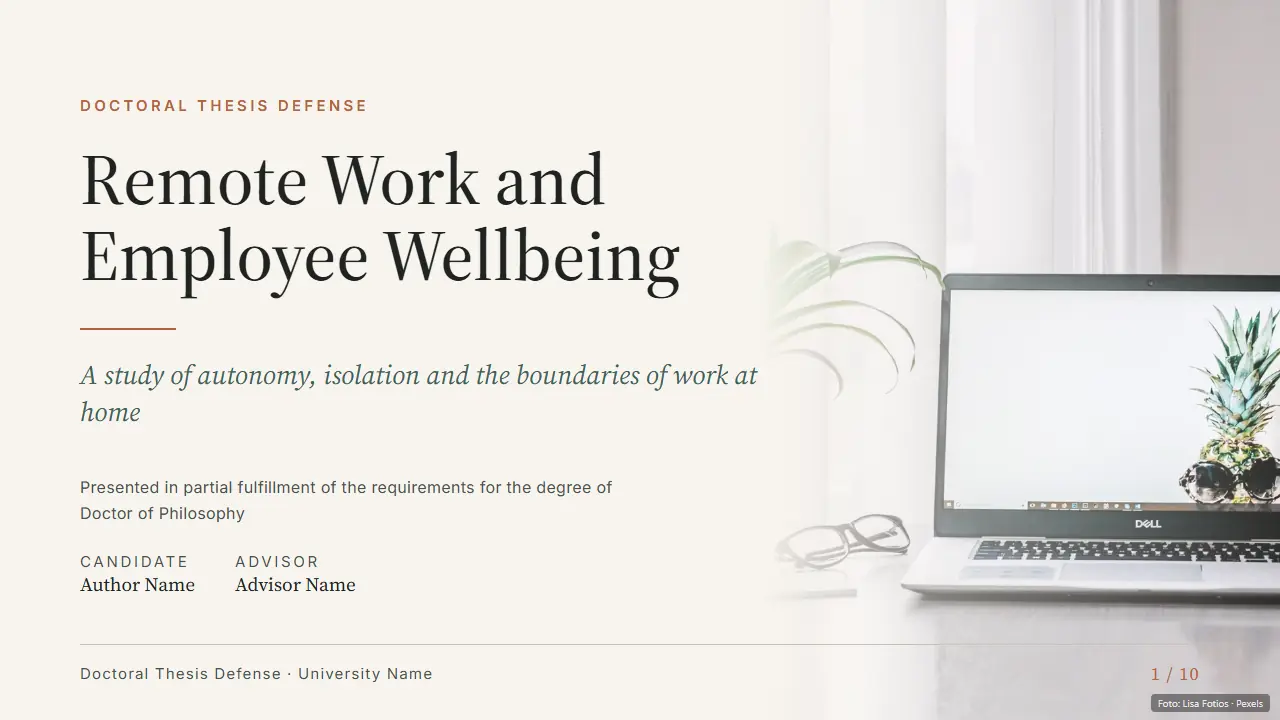
Slide 1 Remote Work and Employee Wellbeing
Doctoral Thesis Defense · A study of autonomy, isolation and the boundaries of work at home · Presented in partial fulfillment of the requirements for the degree of Doctor of Philosophy · Candidate · Author Name · Advisor · Advisor Name
Slide 2 Introduction — Why this question, why now
01 · Introduction · From exception to infrastructure. Remote work has moved from rare arrangement to permanent feature of white-collar employment. · A split debate. Employers emphasize collaboration and culture; employees emphasize flexibility and focus. · The missing middle. Wellbeing sits at the center of the split — productivity is measured, but the human cost and benefit remain contested. · This thesis asks what remote work actually does to employee wellbeing — and under which conditions the effect turns positive or negative. · Prefer remote · of employees worldwide prefer to work fully or almost completely remotely. · State of Remote Work, 2024
Slide 3 Research questions and contribution
02 · Research Questions · RQ1 · How does remote work affect employee wellbeing overall — mental health, work-life balance and job satisfaction? · RQ2 · Which mechanisms drive the effect: autonomy and recovered commute time versus isolation and blurred boundaries? · RQ3 · Under what conditions does remote work protect wellbeing — and when does it erode it? · Contribution
Slide 4 Background — What the literature establishes
03 · Theoretical Framework · The pandemic turned work-from-home into a natural experiment. Reviews of that evidence converge on one framing: outcomes depend on whether resources are lost or gained — and the balance is conditional, not uniform. · Resource loss · Work intensity · workspace limitations · technostress · professional isolation · housework and care demands · Resource gain · Flexibility · autonomy · saved commute time · supportive organizational resources · Systematic review — 48 studies · Organizes pandemic-era work-from-home evidence as resource loss and resource gain.
Slide 5 Method — How the question was studied
04 · Method · Design · Mixed-methods: a quantitative survey of remote and hybrid employees, complemented by qualitative interviews. · Sample · Employees working remotely at least part of the week, across sectors, with an on-site comparison group. · Measures · Validated scales for wellbeing, burnout, work-life balance, professional isolation and perceived autonomy. · Analysis
Slide 6 Findings I — The gains are real
05 · Findings · I · Three consistent gains emerge across the literature on remote work and employee wellbeing. · Autonomy · Control over schedule and environment is the strongest wellbeing gain of remote work — it predicts satisfaction and lower exhaustion. · Time · Recovered time: the disappearance of the commute returns hours to sleep, family and exercise — a consistent resource gain across studies. · Balance · Work-life balance improves when employees can shape the day around life demands — especially for caregivers.
Slide 7 Findings II — The costs are equally real
06 · Findings · II · Professional isolation · Reduced spontaneous interaction erodes belonging; supportive colleagues are the key buffer against loneliness in hybrid work. · MIT Sloan Management Review, 2022 · Blurred boundaries · The home becomes the office; work extends into evenings and recovery time shrinks. · Work intensity & technostress · Constant connectivity and tool overload act as resource losses in the review evidence.
Slide 8 The wellbeing balance sheet
07 · Synthesis · Remote work is a conditional resource: its net effect on wellbeing is the balance between resource gains and resource losses. · Gains. Autonomy, recovered commute time, work-life balance. · Losses. Professional isolation, blurred boundaries, work intensity. · Decisive moderators · Organizational support Social connection Boundary management · All of them designable. · Resource gains Resource losses
Slide 9 Discussion — Implications for organizations
08 · Discussion · The question is not whether people work from home, but what surrounds them when they do. · Thesis position · 01Design for connection · Scheduled, purposeful contact; supportive colleagues are the strongest buffer against isolation. · 02Protect boundaries · Norms about availability and recovery — not just tools. · 03Manage flexibility as a resource
Slide 10 Conclusions, limitations and thank you
09 · Conclusions · I. Conclusions · Remote work affects wellbeing through two opposing mechanisms: autonomy gains and connection losses. · The net effect is conditional — and the conditions are organizational choices. · II. Limitations · Evidence is concentrated in pandemic-era knowledge workers; generalization to other sectors and to fully on-site cultures is limited. · Wellbeing is measured self-reportedly. · Future research
Photos: Foto: Lisa Fotios · Pexels