Example presentation · School
States of matter
What the presentation covers
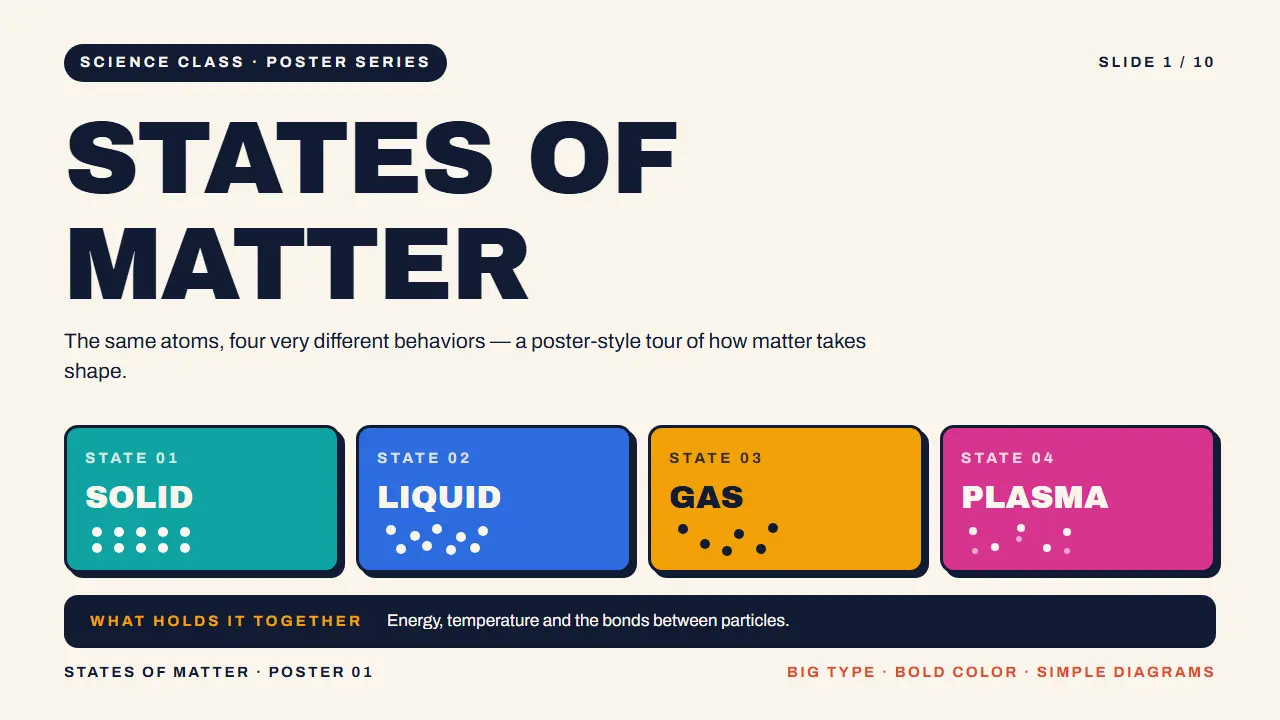
Slide 1 STATES OF MATTER
The same atoms, four very different behaviors — a poster-style tour of how matter takes shape. · State 01 · SOLID · State 02 · LIQUID · State 03 · GAS · State 04
Slide 2 What is matter?
Matter is anything that has mass and takes up space. · Made of particles · Everything is built from tiny particles — atoms and molecules. · Always moving · Particles never stop. Heat makes them move faster. · State = arrangement · The state of matter depends on how the particles are arranged and how strongly they attract each other. · Zoom in — one particle
Slide 3 Solid
Definite shape and definite volume · Particles are packed tightly in a fixed, orderly pattern · They vibrate in place but cannot swap positions · Strong attractions hold the structure together · Particle view — solid · Tightly packed in a fixed, orderly grid — each particle vibrates in place, held by strong attractions. · Examples · Ice Iron Wood Salt crystals
Slide 4 Liquid
States of Matter · Definite volume, but takes the shape of its container. · Particles stay close together but can slide past one another. · Attractions are strong enough to keep them together — not to lock them in place. · Flows, and has a flat surface. · Examples · Water Oil Juice Molten metal · Particles slide, never locked
Slide 5 GAS
No definite shape, no definite volume — it fills whatever holds it. · AIR · STEAM · HELIUM IN A BALLOON · Particles fly fast and free, far apart · Almost no attraction between them — they collide and bounce. Elastic collisions keep the gas spreading in every direction. · Can be squeezed into a smaller space — compressible. Push the particles closer together and the gas just takes less room.
Slide 6 Plasma
States of Matter · 6 of 10 · Gas so hot that electrons are torn from their atoms: an electrically charged soup. · Most common in the universe · Stars are plasma — NASA puts about 99.9% of the visible universe in this state. · Charged and responsive · Conducts electricity and responds to magnetic fields. · It glows · Neon signs Lightning The Sun Auroras
Slide 7 Changes of state
Heat moves right · Cooling moves left · Sublimation — solid → gas directly · Melting → · ← Freezing · Evaporation / Boiling → · ← Condensation · SOLID · LIQUID
Slide 8 Heating curve: why the thermometer stops
Changes of state · Add heat and the temperature climbs — until the change of state begins. · During melting or boiling, all the energy goes into breaking attractions, so the temperature stays flat. · That flat stretch is the melting point or boiling point. · Water: melts at 0 °C, boils at 100 °C (at sea-level pressure).
Slide 9 States of matter around you
Look around: every state of matter is on show — in your kitchen, in the sky, on the street. · Solid Liquid Gas · Water, the everyday shape-shifter · Ice cubes · Packed in place — water as a solid. · Rivers · Flowing and taking the shape of its bed — a liquid. · Steam from a kettle
Slide 10 Recap & quick questions
Solid · Packed, fixed · Particles vibrate in place. · Liquid · Close, sliding · Particles stay near but slide past each other. · Gas · Free, fast