Presentación de ejemplo · Escuela
The respiratory system
Contenido de la presentación
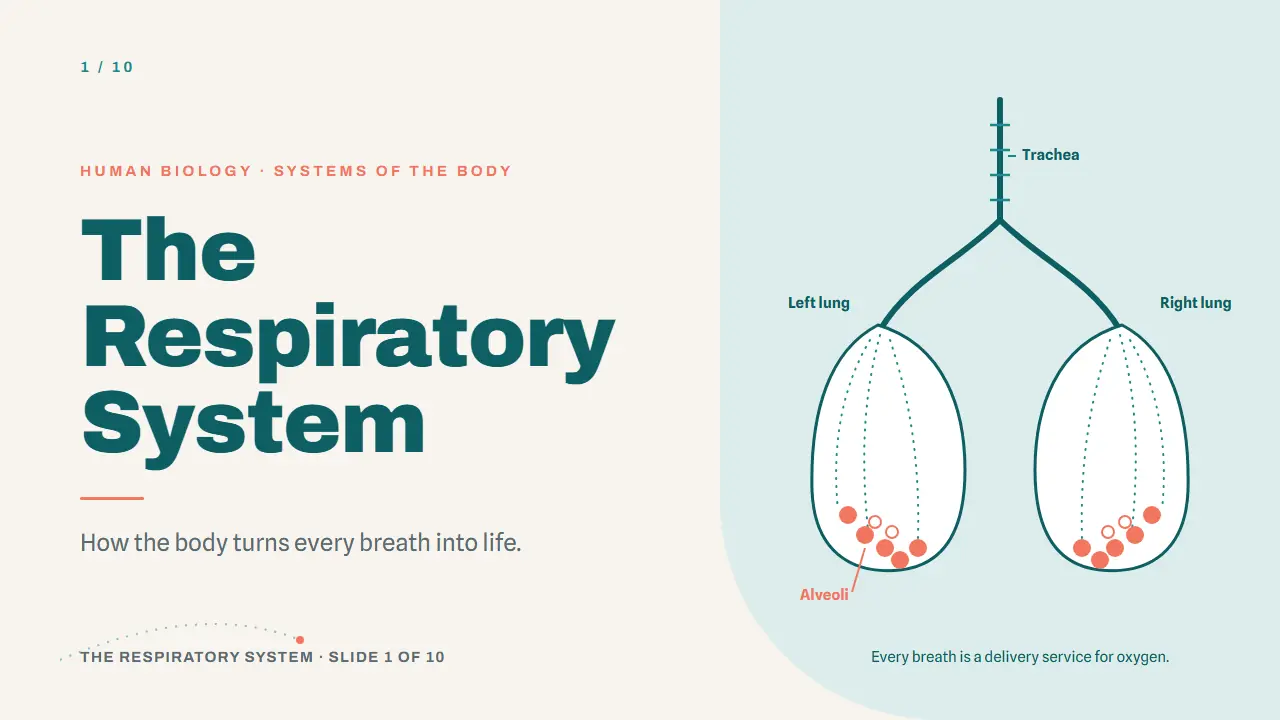
Lámina 1 The Respiratory System
Human biology · Systems of the body · How the body turns every breath into life. · Every breath is a delivery service for oxygen.
Lámina 2 Three jobs, every single second
Why we breathe · Deliver oxygen · Every cell needs O₂ to release energy from food — the process of cellular respiration. · Remove carbon dioxide · The waste product of metabolism leaves the body with each exhale. · Protect and condition · The airway filters dust, warms and humidifies air before it reaches the lungs. · Breathing is automatic — but every breath depends on this system working together
Lámina 3 The path air travels
The journey of air · The trachea splits into two bronchi — one per lung — then branch like a tree into millions of bronchioles. · Did you know? The larynx (voice box) also lets us speak.
Lámina 4 The lungs, up close
Anatomy · Wrapped in pleura · Two lungs sit inside the rib cage, wrapped in a smooth membrane called the pleura. · Three lobes, two lobes · The right lung has 3 lobes; the left has 2 — the heart makes room in between. · The engine below · The diaphragm, a dome of muscle under the lungs, is the main engine of breathing. · Did you know? Lungs are the only internal organs light enough to float on water.
Lámina 5 The alveoli: where blood meets air
Gas exchange · 100 m² · Total surface area of the alveoli — the respiratory surface, about the size of a racquetball court. · ~480 million · Tiny air sacs per pair of lungs (Ochs et al., 2004), each wrapped in a net of capillaries. · A wall just one cell thick — thin enough for gases to pass in seconds. · Oxygen — diffuses into the blood Carbon dioxide — diffuses out
Lámina 6 How breathing works
Mechanics of breathing · 1Inhale Air rushes in · The diaphragm contracts and flattens, the rib cage lifts — the lungs expand and air rushes in. · 2Exhale Air flows out · The diaphragm relaxes and domes up, the lungs recoil and air flows out. · ~500 mL of air moves with each quiet breath — the tidal volume · 12–20 breaths per minute at rest
Lámina 7 Oxygen on the move
Transport · Oxygen binds to hemoglobin, the iron-rich protein packed inside red blood cells. · Each hemoglobin molecule can carry up to 4 oxygen molecules at once. · Carbon dioxide mostly travels dissolved in plasma as bicarbonate, back to the lungs. · O₂ per hemoglobin — the ride is bound to hemoglobin, not free in plasma. · HCO₃⁻ in plasma — most CO₂ returns as bicarbonate. · A single drop of blood carries millions of red cells — each a tiny oxygen ferry.
Lámina 8 The rhythm controller
Control · Why you can’t hold your breath forever · As CO₂ builds up, blood grows more acidic. The brain reads it as an alarm and speeds up breathing to clear it — the urge to breathe becomes impossible to ignore. · Automatic adjustments · Breathing also responds to exercise, emotion and altitude — automatically. · Who sets the rhythm? A closed feedback loop between brain, muscles and lungs.
Lámina 9 When the system struggles
When breathing fails · Asthma · Airways inflame and narrow, causing wheezing and shortness of breath — often triggered by allergens. · COPD · Airflow becomes restricted, mostly from smoking and air pollution. · A leading cause of death worldwide (WHO). · Pneumonia · An infection fills the alveoli with fluid, making gas exchange harder.
Lámina 10 Closing — Make them count
Take care of your lungs · Every breath you take is a job well done. Make them count. · Four simple habits keep your lungs working at their best, every single day. · Don't smoke · The single best thing you can do for your lungs. · Move · Aerobic exercise trains your breathing muscles and capacity. · Mind your air