Example presentation · School
The periodic table
What the presentation covers
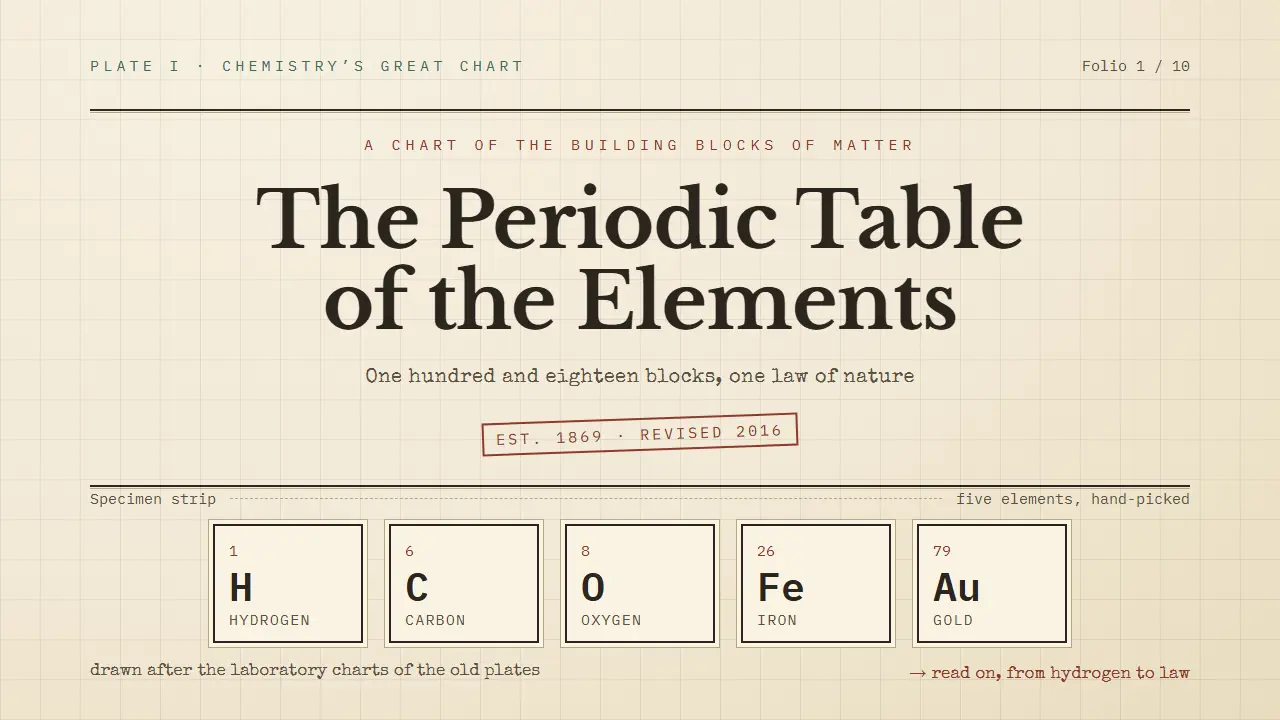
Slide 1 The Periodic Table of the Elements
A Chart of the Building Blocks of Matter · One hundred and eighteen blocks, one law of nature · Est. 1869 · Revised 2016 · Specimen strip five elements, hand-picked · Hydrogen · Carbon · Oxygen · Iron
Slide 2 What Is an Element?
Plate II · First Principles · The definition · An element is a substance that cannot be broken into simpler substances by chemical means. · § 1 · Every element has an atomic number: the count of protons in its nucleus — hydrogen is 1, carbon is 6, uranium is 92. · § 2 · The table arranges all known elements in order of atomic number, 1 to 118. · THE ORDER OF THE TABLE, BY ATOMIC NUMBER
Slide 3 Before Mendeleev
Plate III · History · Eighty Years of Sorting · LavoisierPublishes a list of 33 known elements · DöbereinerNotices triads: groups of three with related properties · 1860s · NewlandsLaw of octaves: every eighth element repeats · the decisive step · Dmitri MendeleevA Russian chemist arranges 63 elements by atomic weight — and leaves deliberate gaps
Slide 4 Mendeleev’s Blank Spaces
Plate IV · The Prediction · He left gaps where no element was known — and dared to describe what would fill them. · № — predicted · Eka‑ Aluminium · blank space · becameGallium · 1875 · predicted weight ~68 matched the prediction · Eka‑ Boron
Slide 5 How to Read a Tile
Plate V · Reading the Chart Fig. 5 — Anatomy of a Specimen Tile · 26 Fe Iron ferrum · Atomic Number · protons in the nucleus · Symbol · the element's mark · Name · iron — the worker's metal
Slide 6 The Families at a Glance
Plate VI · The Map · Chart · 18 Columns · each shade = one family · Lanthanides · 57–71 · Actinides · 89–103 · Alkali metals · Group 1 · Soft, violently reactive metals — lithium, sodium, potassium. · Alkaline earths · Group 2
Slide 7 Metals, Metalloids, Nonmetals
Plate VII · Three Kinds of Matter · Fig. 7 — Classification of the elements by shared properties · I · Metals · 26 Fe Iron · 13 Al Aluminium · 29 Cu Copper · 47 Ag Silver · Shiny
Slide 8 Four Elements Worth Knowing
Plate VIII · Element Stories · 3 Li Lithium · Specimen · Light MetalLight enough to float on water — and now it powers every phone and electric car battery. · 26 Fe Iron · Specimen · Core MetalThe core of our planet and of every steel beam. Forged stars make it; supernovae scatter it. · 2 He Helium · Specimen · Noble GasFirst found in the Sun's spectrum in 1868 — 27 years before it was found on Earth. · 118 Og Oganesson
Slide 9 Periodic Trends
Plate IX · The Law in Motion · Across a Period — Atoms Shrink · More protons pull the same electron shells tighter. · radius contracts left → right · Down a Group — Atoms Swell · Each new period adds a whole new shell. · shells stack top → bottom · Electronegativity rises toward the top right
Slide 10 118 and Counting
Plate X · The Table Today PLATE 10 OF 10 · The modern table is ordered by atomic number, not weight — a fix made possible once protons could be counted. Every box now sits where the count of protons says it must. · Z p⁺ · Atomic number: the count of protons, not the weight, decides the order. · Everything beyond uranium is synthetic — assembled atom by atom in particle accelerators, one collision at a time. · Oganesson's most stable isotope lasts 0.89 milliseconds — the table's heaviest entry is also its most fleeting. · Recent Acquisitions Drawer VII · Nh Nihonium Japan · RIKEN 113