Example presentation · Marketing
Marketing plan
What the presentation covers
Slide 1 Craft Brewery Marketing Plan
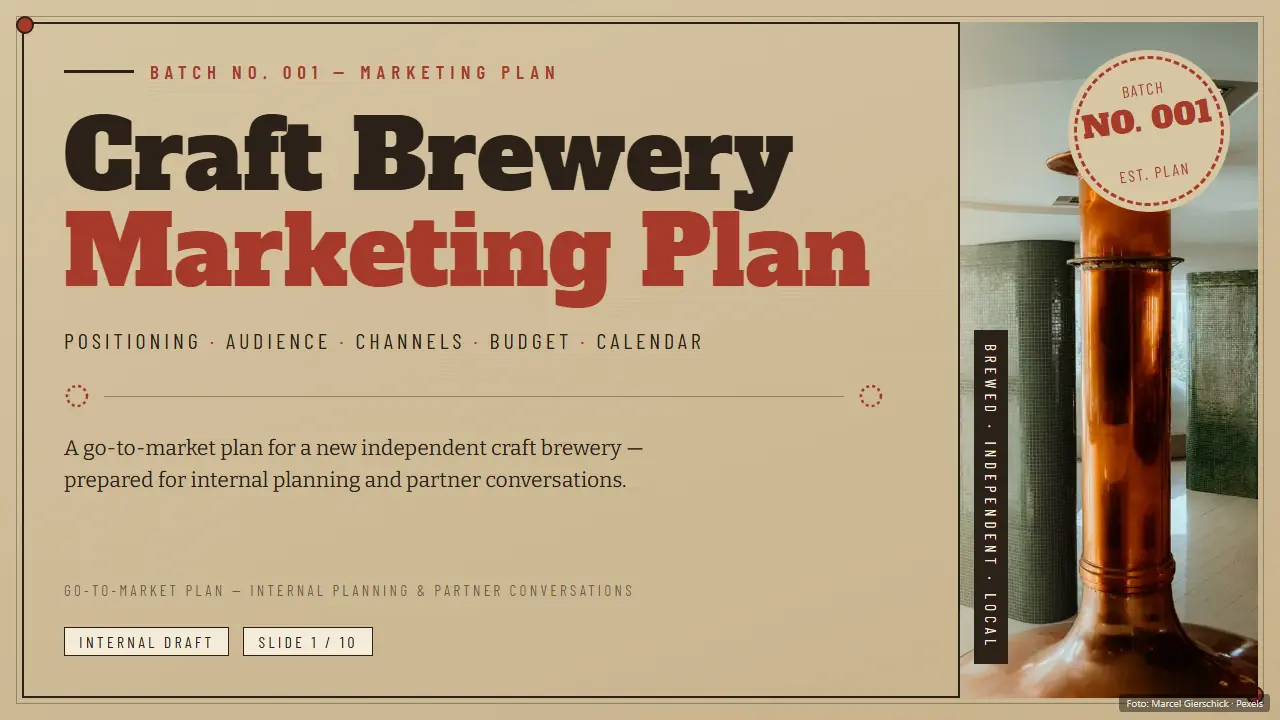
Brewed · Independent · Local · Batch No. 001 Est. Plan · Batch No. 001 — Marketing Plan · Positioning ·Audience ·Channels ·Budget ·Calendar · A go-to-market plan for a new independent craft brewery — prepared for internal planning and partner conversations. · Go-to-market plan — internal planning & partner conversations
Slide 2 The Market We're Entering
The Landscape · A category worth billions, still taking shelf space — but the rising tide has stopped. The next decade of craft growth belongs to breweries with a distinct brand. · Market Check — 2025 — · U.S. Volume · Craft Share of U.S. Beer · And craft grew its share even in a down market. (Brewers Association, 2025 data) · U.S. Dollars · $28.0B
Slide 3 Positioning: The Local, Made Distinct
Why we win · The opening · Drinkers are trading fewer, better beers — and local, independent carries real premium. · Taproom-first economics: direct sales keep margin and build community. · Most local competitors compete on volume, not on brand story. · Position · Our position · A neighborhood brewery with an unmistakable identity — one look, one voice, one promise — on every can, glass and post.
Slide 4 Three Audiences, One Community
Who we pour for · Local Regulars · Live or work nearby and visit weekly — they follow us on Instagram, and the taproom is their third place. · Weekly Third place · Curious Explorers · Seek new releases and limited drops, share their finds online, and drive weekend traffic. · Limited drops Weekends · Gift & Occasion Buyers
Slide 5 Four Pillars of the Brand
Brand system · Batch 5 of 10 · Made Here · Every beer tied to the place — local ingredients, local names, local stories. · Honest Craft · Show the process: open brew days, brewer notes on every can, no mystique. · Built for Company · The taproom as a gathering place — events, clubs, community nights.
Slide 6 Product Strategy: Core & Drops
Product — Approved · The Structure · Core Range — 3–4 Year-Round Beers · One flagship everyone can order, plus style variety for breadth. The pours that build habit. · Seasonal & Limited — Every 6–8 Weeks · Rotating releases that give regulars a reason to return. The drops that build buzz. · Flagship First · The core pours build habit; the limited drops build buzz. Both engines run together.
Slide 7 Sales Channels: Direct First
Where the beer goes · Taproom & Direct First · Highest margin — every pint sold at home earns more · Immediate feedback — hear it from the drinker, same night · The brand's home ground — the room itself is the marketing · Direct extras — growlers & crowlers, merch, private events, club memberships · Wholesale Second · A handful of nearby bars — once volume allows
Slide 8 Marketing Channels That Fit Craft
Getting the word out · Tactics Channel Plan · Owned & Earned · Instagram & Short Video · The taproom is content — brew days, pours, people. 3–4 posts a week, reels over stills. · Events & Calendar · Trivia, live music, food trucks, release nights — a full calendar that turns visits into habits. · Local Partnerships
Slide 9 Budget Allocation
Batch No. 09 — of 10 · Where every dollar goes · Planned shares of the total marketing budget, largest first — the bars show relative weight. Set the exact split in dollars once the budget is fixed. · Events & taproom programming · Largest share · Content & social production · Second tier · Signage, glassware & merch
Slide 10 Roadmap & What We Measure
The road ahead · Roadmap · Batch 01 · Pre-Launch · Brand assets finished · Socials seeded · Launch event planned · Press list built · First 90 Days
Photos: Foto: Marcel Gierschick · Pexels