Example presentation · School
The human digestive system
What the presentation covers
Slide 1 The Human Digestive System
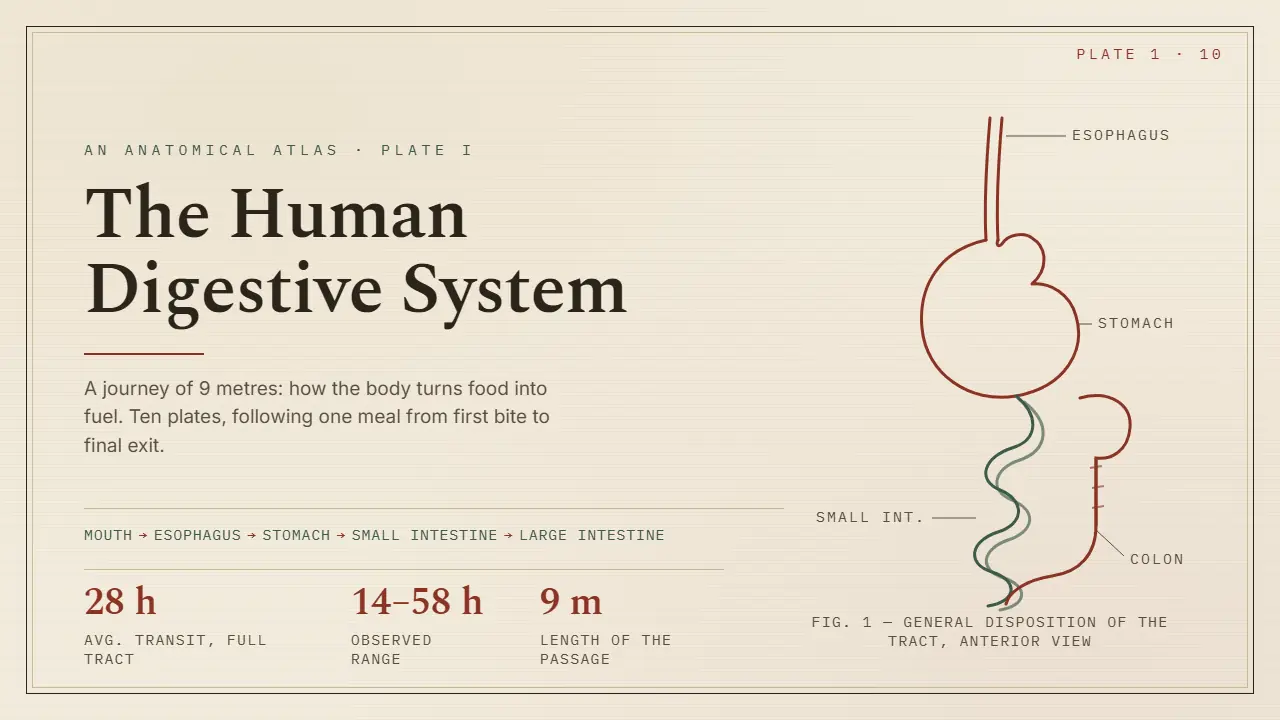
Plate 1 · 10 · An Anatomical Atlas · Plate I · A journey of 9 metres: how the body turns food into fuel. Ten plates, following one meal from first bite to final exit. · Mouth → Esophagus → Stomach → Small Intestine → Large Intestine · 28 h · AVG. TRANSIT, FULL TRACT · 14–58 h · OBSERVED RANGE
Slide 2 The Route of the Meal
Plate II · Overview · One continuous tube — the gastrointestinal tract — carries the meal from mouth to anus, about 9 metres long. · Three helpers alongside · Liver, gallbladder and pancreas deliver bile and enzymes to the passing food. · Mechanical · Chewing and churning break food into pieces. · Chemical · Enzymes and acid break it down further.
Slide 3 Plate 1 · The Mouth
Plate III · First Station · Where Digestion Begins · Chewing breaks food into smaller pieces — mechanical digestion starts here. · Saliva, about 1–1.5 litres a day, moistens food and contains amylase, an enzyme that begins breaking down starch. · The tongue shapes food into a soft ball (bolus) and pushes it to swallow. · Saliva also protects teeth and starts taste. · Fig. 1 — Cross-section of the oral cavity: teeth, tongue and salivary glands
Slide 4 Plate 2 · Esophagus & Stomach
Plate IV · The Descent · The Path of Food · Stage Two · Fig. 4–5 · Engraved after the classical atlases · Fig. 4 · Down the Esophagus · Peristalsis: waves of muscle squeeze the bolus down the 25 cm esophagus in about 8 seconds. · Fig. 5 · Into the Stomach
Slide 5 Plate 3 · The Small Intestine
Plate V · The Engine Room · Absorption Champion · About 6–7 metres long, the small intestine runs through the abdomen in three successive parts. Most chemical digestion happens in the duodenum, where bile and pancreatic enzymes arrive to break the food down. · Duodenum enzymes · Jejunum absorb · Ileum absorb · Villi and microvilli — tiny finger-like folds, 0.5–1.6 mm — multiply the absorbing surface at every step of the tube. · ≈30–40 m²
Slide 6 Plate 4 · Accessory Organs
Plate VI · The Chemical Works · Liver, Gallbladder & Pancreas · The Liver · The body's largest internal organ — produces bile, which emulsifies fat into droplets. · The Gallbladder · Stores bile and squirts it into the duodenum when fat arrives. · iii · The Pancreas
Slide 7 Plate 5 · The Large Intestine
The Final Stretch · Water & waste. About 1.5 metres long and wider than the small intestine, it closes the path of food. · Its main job: reclaim water and salts — about 1–1.5 litres a day — turning chyme into solid stool. · ii. · Remains pass through the colon, wait in the rectum, and leave through the anus. · Fig. note — Microbiome · Home to trillions of bacteria that ferment fibre and make vitamins B and K. · Fig. 5 — The Colon Frame
Slide 8 How Long Does It All Take?
Hours of Transit · The full journey — mouth to colon — runs 14–58 hours, averaging 28 hours. Each leg keeps its own pace. · Mouth & Esophagus · < 1 min · Under a minute · Stomach · 2–5 h · 2–5 hours of churning
Slide 9 Plate 7 · The Chemistry Kit
Plate IX · Enzymes & Juices · Along the path, each station adds its own chemical agents — enzymes and juices that take apart the meal, station by station. · Salivary amylase · Mouth · Starts working on starch from the first bite · ii. · Pepsin · Stomach, in acid
Slide 10 Closing · The Atlas Complete
Plate X · Finis · One Meal, One Machine — from bite to exit: about 9 metres of tube, three accessory organs, and roughly 28 hours. · Break down · mouth, stomach, enzymes · Absorb · villi in the small intestine · Reclaim · water and salts in the colon